


Fill the grid so every row, every column, and every 3x3 box contains the digits 1 to 9 exactly once. We will use a few Sudoku terms to make that rule easier to see.
Sudoku is played on 81 cells arranged as 9 rows and 9 columns. Empty cells are the places you fill in.
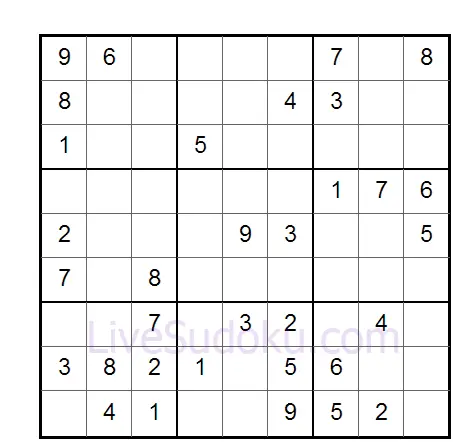
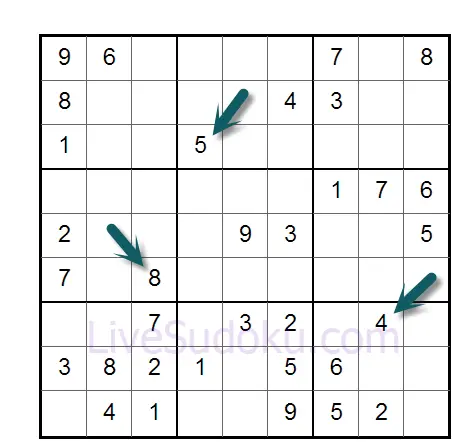
When you start a fresh Sudoku, some cells already contain digits. These givens cannot be changed, and all the other cells are for you to solve.
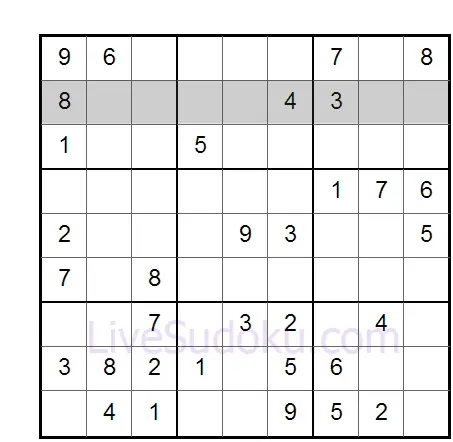
The grid has 9 rows, numbered from 1 to 9 from top to bottom. In this example, row 2 is highlighted.
The grid also has 9 columns, numbered from 1 to 9 from left to right. Here, column 2 is highlighted.
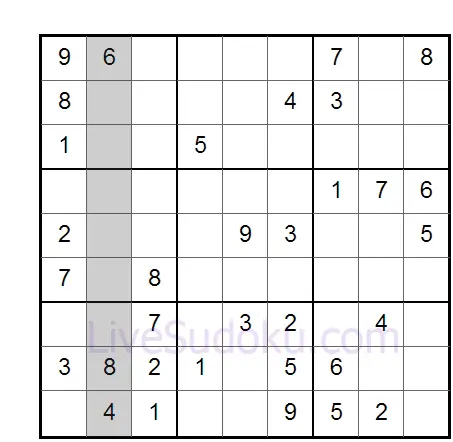
Sudoku also has boxes, sometimes called blocks. A box is one of the 3x3 areas separated by the thicker grid lines.
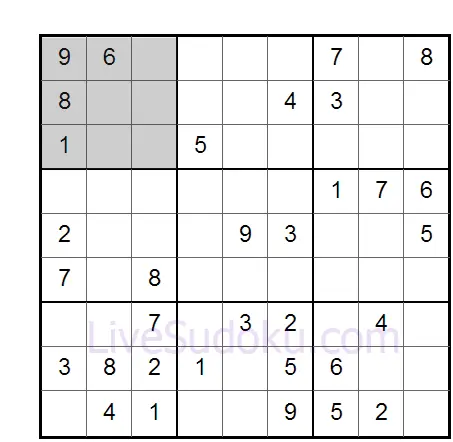
Every box follows the same rule: it must contain each digit from 1 to 9 exactly once.
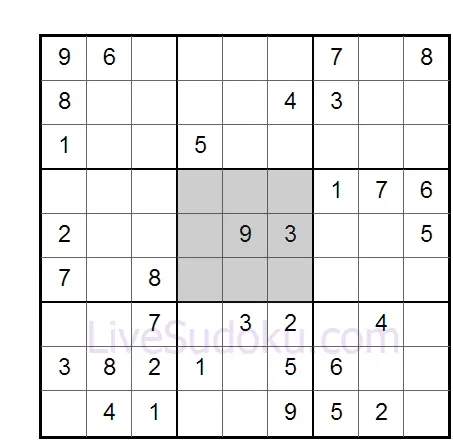
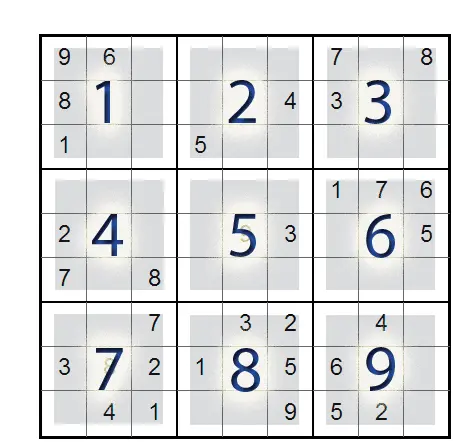
There are 9 boxes in total. They are numbered in reading order: across the top row of boxes, then the middle row, then the bottom row.
The tutorials use a row legend on the left and a column legend on top. Rows are shown in red, and columns are shown in blue.
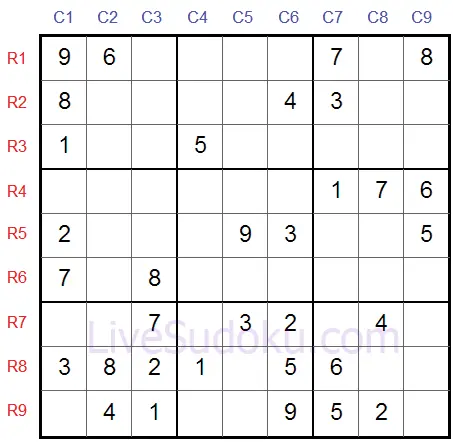
The highlighted cell is R5C6. It is on row 5 and column 6.

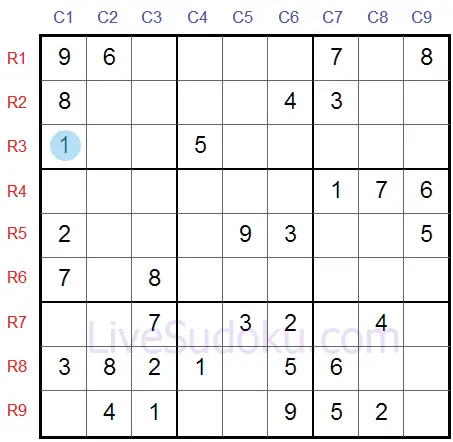
This highlighted cell is R3C1. It is on row 3 and column 1.
A key part of learning Sudoku is understanding houses. Whenever we say house, we mean a row, a column, or a box.
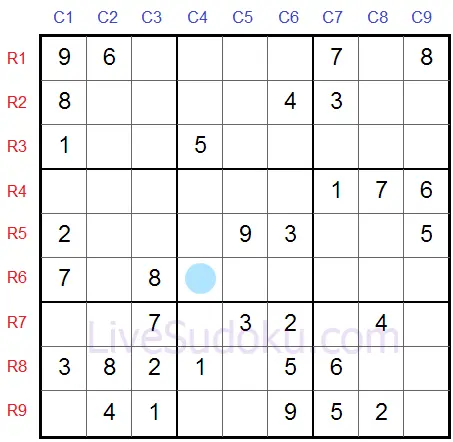
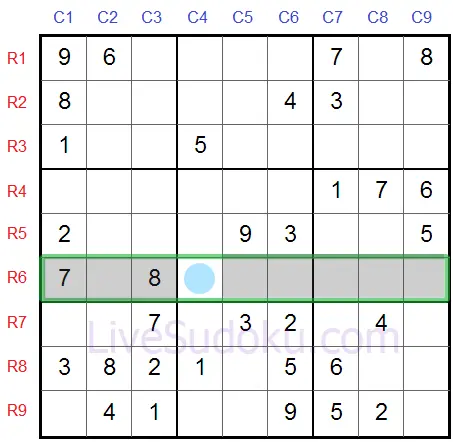
Here the highlighted cell is R6C4. Its row, column, and box will tell us which digits cannot go there.
All the cells in row R6 are buddies with R6C4.
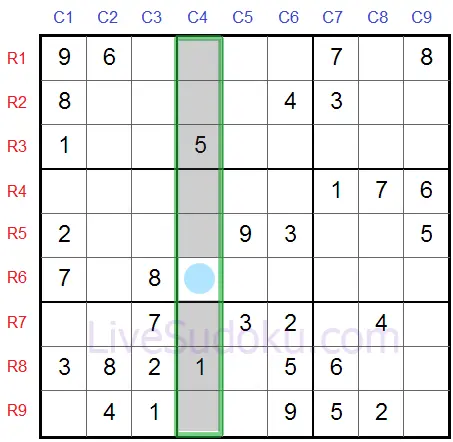
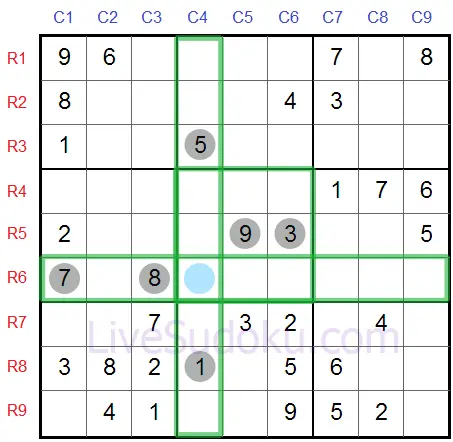
All the cells in column C4 are also buddies with R6C4.
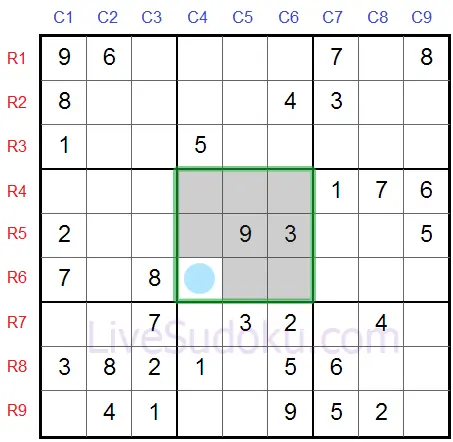
All the cells in the same 3x3 box are buddies with R6C4 too.
R6C4 is a buddy of every highlighted cell here.
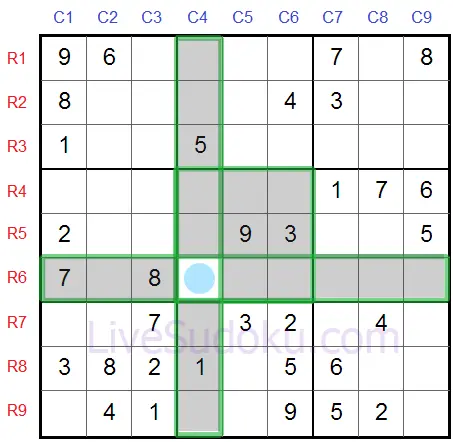
Because a digit can appear only once in any row, column, or box, a buddy cell cannot contain the same digit as R6C4.
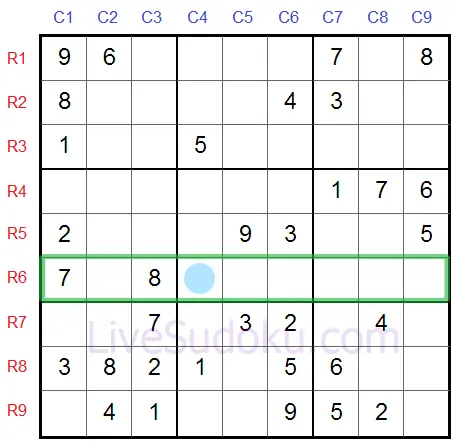
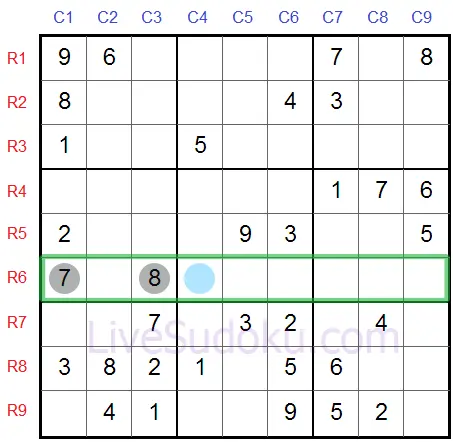
In row R6, there is a 7 at R6C1 and an 8 at R6C3. So R6C4 cannot be 7 or 8.
Looking at all buddies, R6C4 also sees 5 and 1 in its column, plus 9 and 3 in its box. Those digits cannot go in the cell either.
Before moving to solving techniques, remember that a proper Sudoku has exactly one solution - every LiveSudoku puzzle is built that way. That is what lets you fill the grid with logic only, without guessing.
Lesson complete
Nice work - you went through every step. Ready for the next lesson?
Next: Sudoku RulesThe basic rule of Sudoku
To complete a Sudoku, fill the empty cells so that each row, each column, and each 3x3 box contains all the digits from 1 to 9.
Each digit can appear only once in any row, column, or box. Everything else in Sudoku is a careful way of applying that one rule.
How the Sudoku grid works
Before you make moves, learn the parts of the grid. These terms explain where digits can go and why one placement can affect many nearby cells.
Cells and givens
Sudoku is played on a grid of 81 cells: 9 rows by 9 columns. Empty cells are the squares you solve.
Some cells already contain digits when the puzzle starts. These fixed starting digits are called givens or clues, and they do not change during the game.
Rows, columns, and boxes
Rows are the horizontal lines of the grid and are numbered 1 to 9 from top to bottom.
Columns are the vertical lines and are numbered 1 to 9 from left to right.
Boxes, also called blocks, are the nine 3x3 regions separated by thicker lines. They are numbered across the grid from top-left to bottom-right.
Legend and cell numbering
Throughout the lessons, rows are shown in red on the left and columns are shown in blue on top.
A specific cell is named by its row and column. For example, R5C6 means row 5, column 6.
Houses
A house is any row, column, or box. Each Sudoku grid has 27 houses: 9 rows, 9 columns, and 9 boxes.
The basic rule applies to every house: each digit from 1 to 9 appears once.
Buddy cells
Buddy cells are cells that share a house. Two cells are buddies if they are in the same row, the same column, or the same box.
Buddy cells affect each other because the same digit cannot appear twice in a house.
Walk through this in steps 13-20 of the guided example above
Solve with logic, not guessing
Now that you know what buddy cells are, you can see why they matter: a cell cannot contain a digit already used by one of its buddies.
A valid Sudoku has only one solution, and it can be solved by logic. If a move depends on guessing, keep scanning the houses and buddy cells instead.
Full House / Last Digit
Full House and Last Digit describe the same beginner idea. When a house has eight filled cells and one empty cell, the empty cell must be the missing digit.
This is usually the easiest safe Sudoku move. The full guided lesson now lives on its own page so beginners can practice the technique step by step.
How to make your first moves
Beginners should start with the most constrained parts of the grid. A nearly complete row, column, or box often reveals a forced move before you need pencil marks.
- Scan rows, columns, and boxes that are almost complete.
- Look for a house with one missing digit.
- Check the empty cell against its buddies.
- Place the digit only when the rule proves it.
- Use pencil marks when scanning no longer finds a safe move.
What to learn next
Common beginner mistakes
The most common mistakes are repeating a number in a row, column, or box; guessing too early; changing a given; forgetting to update pencil marks; and starting with puzzles that are too hard.
Practice Sudoku now
Frequently asked questions
Do you need math to play Sudoku?
No. Sudoku uses logic and pattern recognition, not arithmetic.
Can a number repeat in Sudoku?
A number cannot repeat in the same row, column, or 3x3 box.
What are givens in Sudoku?
Givens are the starting numbers printed in the puzzle. They are clues and should not be changed.
What is a house in Sudoku?
A house is any row, column, or 3x3 box.
What are buddy cells?
Buddy cells are cells that share a row, column, or box, so they cannot contain the same digit.
What is the easiest way to start a Sudoku puzzle?
Look for a row, column, or box with only one missing number.
Should beginners use pencil marks?
Yes, but only after easy scanning no longer finds a move.
Is guessing allowed in Sudoku?
You can guess, but learning logic techniques is safer and more satisfying.