


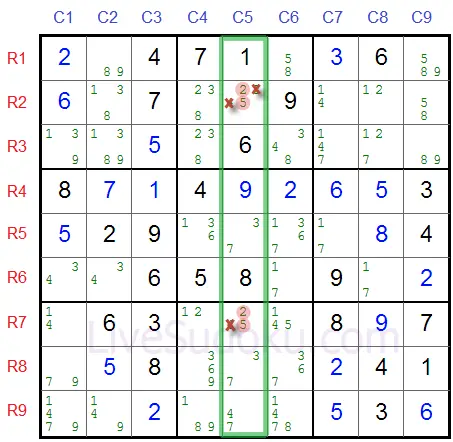
Take a look at column 5. R2C5 and R7C5 both have 2 and 5 as candidates, and no other cell in this column allows 2 or 5.
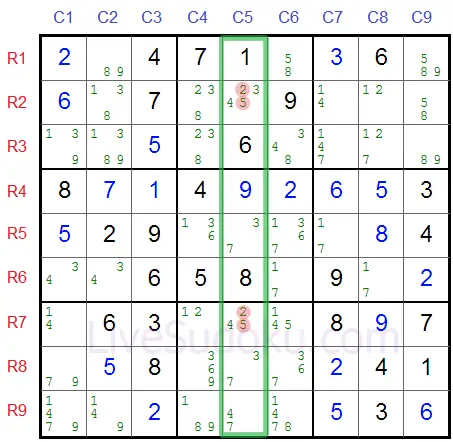
It is certain that R2C5 and R7C5 will be 2 and 5 in some order.
So every other candidate can be eliminated from those two cells, leaving a clean naked pair.
Look at the top-right box. Digit 5 can only go in R2C9 or R3C9; digit 6 only in R2C7, R2C9, or R3C9; and digit 7 only in those same three cells.
Three digits, and between them only three possible cells. That is a hidden triple, even though no single cell shows all three digits - R2C7 has no 5 at all.
The digits 5, 6, and 7 must fill R2C7, R2C9, and R3C9 in some order - if any of those cells took a different digit, one of the three would have nowhere left to go in the box.
So every other candidate in those three cells can be erased: 2, 4, 8, and 9 leave R2C7, and 4, 8, and 9 leave the other two cells. What remains is a much simpler pattern, and often a follow-up single.
Lesson complete
Nice work - you went through every step. Ready for the next lesson?
Next: Advanced Sudoku TechniquesThe hidden pair rule
A hidden pair is two digits that can only go in the same two cells of a house, even though those cells still show other candidates. Since the two digits must occupy those two cells, every other candidate can be removed from them.
The pair is "hidden" because it is buried under extra pencil marks. The payoff is cleaning those cells down to two candidates each.
Worked example: a hidden pair in a column
Scan one house at a time and ask, for each digit, which cells could still take it. When two digits share the same two possible cells, you have found the pattern.
Hidden triples and quadruples
The same logic scales up. A hidden triple is three digits that can only fit in the same three cells of a house; a hidden quadruple uses four digits and four cells. All other candidates can be removed from those cells.
Hidden triples are harder to spot than pairs because the digits rarely appear in every one of the three cells. Count possible positions per digit rather than reading cell by cell. Here is a real one, taken mid-solve from a hard LiveSudoku puzzle.
How to find hidden pairs
Hidden pairs are found with pencil marks, but you do not need to mark the entire grid. Choose rows, columns, or boxes that are mostly solved, fill in their candidates, and check which digits are restricted to two cells.
A useful habit: after any elimination, re-scan the house. Hidden pairs frequently turn into naked pairs, which then eliminate candidates elsewhere.
Frequently asked questions
What is the difference between a hidden pair and a naked pair?
A naked pair has only its two digits visible in the cells and eliminates them from the rest of the house. A hidden pair sits under extra candidates and eliminates those extras from its own two cells.
Does a hidden pair solve a cell?
Not immediately. It reduces two cells to two candidates each, which usually enables follow-up moves in the same house.
Where should I look first?
Houses with many solved cells. The fewer empty cells a house has, the easier it is to see which digits are restricted to two positions.
Practice next
Hidden pairs reward careful candidate work. Practice on hard puzzles, filling pencil marks for one nearly finished house at a time.