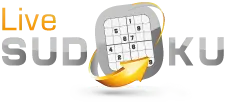


XY-Wing starts with a cell that has only two candidates, called the pivot. In this example R5C5 is the pivot, with X=6 and Y=9.

Next, look for two more bi-value cells that are buddies of the pivot. These are the pincers: one must hold X and Z, the other Y and Z.
Here Z=7. The pincers are R5C2 with candidates 6 and 7 (X=6, Z=7), and R8C5 with candidates 9 and 7 (Y=9, Z=7).
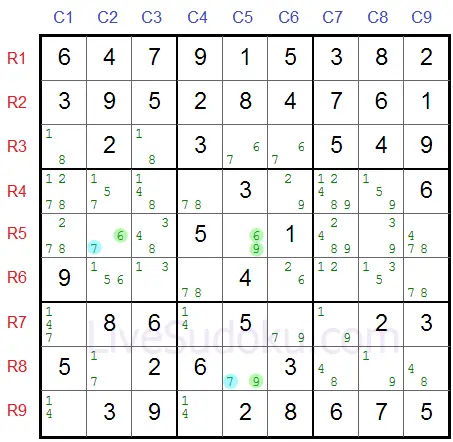
If the pivot R5C5 is 6 (X), then R5C2 loses its 6 and must be 7 (Z). The other pincer is not forced - here it is shown taking 9 - but that no longer matters: a pincer already holds the 7.
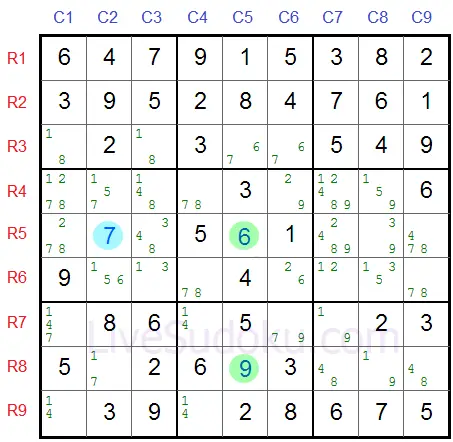
If the pivot is 9 (Y) instead, then R8C5 loses its 9 and must be 7 (Z). This time R5C2 is the pincer left free - shown taking 6 - and again a pincer holds the 7.
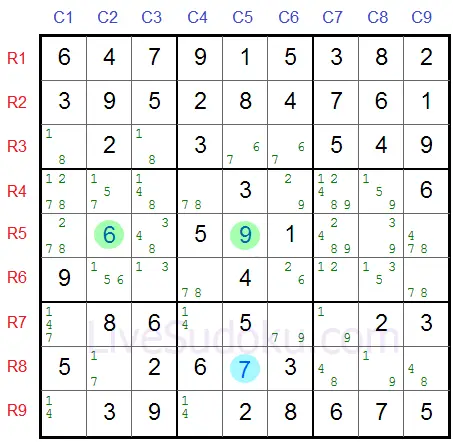
Both options force one of the pincers, R5C2 or R8C5, to be 7 (Z). The 7s are marked in blue.

Any cell that is a buddy of both R5C2 and R8C5 cannot contain 7 (Z).

R8C2 sees both pincers, so 7 can be removed from its candidate list.

In this example R7C1 is the pivot.

R2C1 is one pincer, in the same column as the pivot. R9C3 is the second pincer, in the same box as the pivot.
Here X=7 and Y=9; Z=3 is marked in blue.

Any cell that sees both R2C1 and R9C3 cannot be 3 (Z). The buddy cells of both pincers are marked in blue.
Can you find which cells cannot be a 3?

Both R2C3 and R3C3 qualify: they share a box with the first pincer and a column with the second pincer.

Remove 3 from the candidates of both cells. An XY-Wing is not limited to one elimination; it applies to every cell that sees both pincers.

Lesson complete
Nice work - you went through every step. Put it into practice on a real puzzle.
Play Sudoku nowWhat XY-Wing is
XY-Wing, also called Y-Wing, is an advanced elimination technique built from three cells that each have exactly two candidates: one pivot and two pincers. Whatever value the pivot takes, one of the pincers is forced to contain a shared candidate called Z, so Z can be removed from every cell that sees both pincers.
XY-Wing does not place a digit directly. Like other advanced patterns, it removes candidates so that simpler moves appear.
Pivot and pincers
The pattern starts with a bi-value cell called the pivot. Its two candidates are called X and Y.
The pivot is connected to two more bi-value cells, the pincers. One pincer holds X and Z, the other holds Y and Z, where Z is any third digit.
Why one pincer must contain Z
The pivot has only two possible values, and each one forces a different pincer to become Z. That is the whole trick: no matter which way the pivot resolves, one pincer ends up as Z.
The elimination rule
Because one pincer is always Z, any cell that is a buddy of both pincers can never be Z. Remove Z from the candidate list of every such cell.
A second example: the bent shape
The first example looked like an X, but an XY-Wing does not need that shape. The pincers only need to be buddies of the pivot: same row, same column, or same box.
How to find XY-Wings
XY-Wings need clean pencil marks. If your candidates are out of date, update them before searching for the pattern.
- Scan for bi-value cells: cells with exactly two candidates.
- Pick one as a possible pivot and note its candidates X and Y.
- Look among its buddy cells for one pincer with X and Z, and another with Y and Z.
- Find every cell that sees both pincers and remove Z from its candidates.
- Re-check the affected houses; the eliminations often reveal a naked or hidden single.
XY-Wing vs Y-Wing
XY-Wing and Y-Wing are two names for exactly the same technique. Some solvers and books also describe it as a short XY-chain of three cells. Whatever the name, the logic is identical: a pivot with X and Y, two pincers with X-Z and Y-Z, and Z eliminated from cells that see both pincers.
Frequently asked questions
Is XY-Wing the same as Y-Wing?
Yes. XY-Wing and Y-Wing describe the same pattern: one bi-value pivot, two bi-value pincers, and the shared candidate Z removed from cells that see both pincers.
Does an XY-Wing place a digit?
No. XY-Wing is an elimination technique. It removes a candidate, and that removal usually unlocks a simpler placement such as a naked single.
What should I learn before XY-Wing?
Be comfortable with pencil marks, singles, and simpler eliminations such as locked candidates and X-Wing. XY-Wing appears mostly in hard and evil puzzles.
Practice next
XY-Wings appear in harder puzzles where candidates must be managed carefully. Keep your pencil marks clean and scan bi-value cells after every placement.