


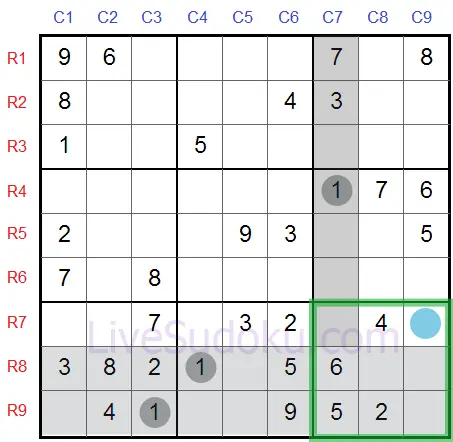
In this example, focus on the marked 3x3 box and ask one question: where can the digit 1 go inside this box?
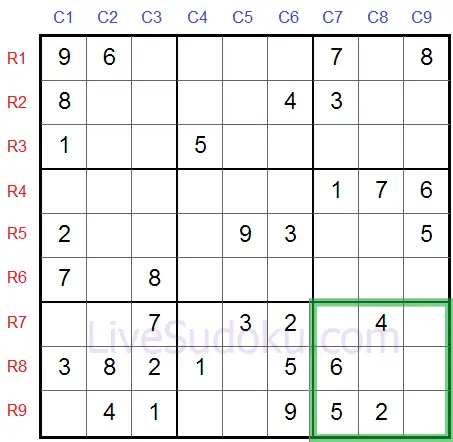
R8C4 already contains 1, so no other cell in row 8 can contain 1. That removes the row-8 cells from consideration inside the marked box.
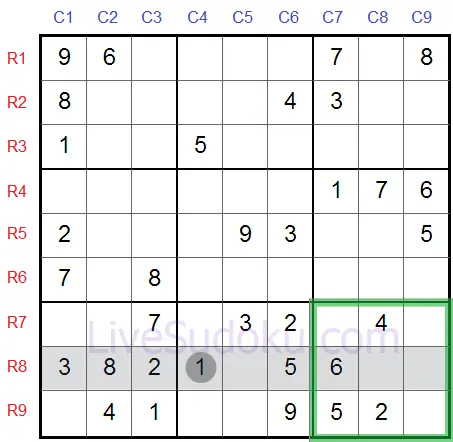
R9C3 already contains 1, so row 9 cannot contain another 1. More cells in the marked box are no longer legal.
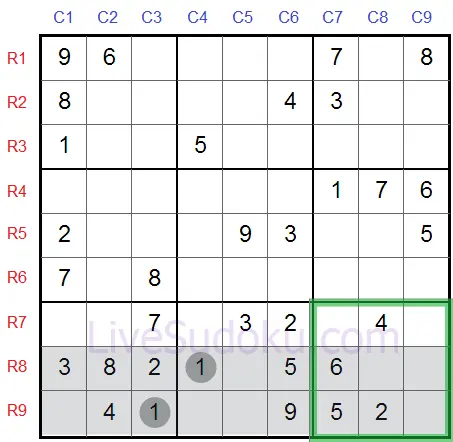
R4C7 contains 1, so column 7 cannot contain another 1. That removes the column-7 cells in the marked box.
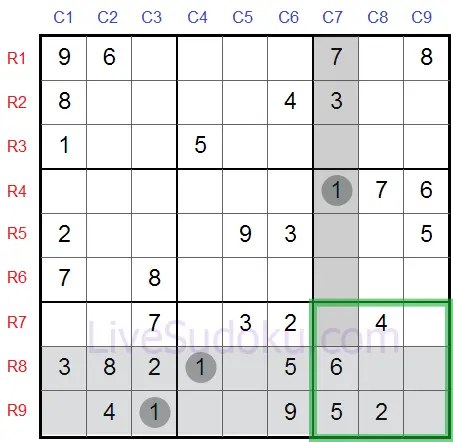
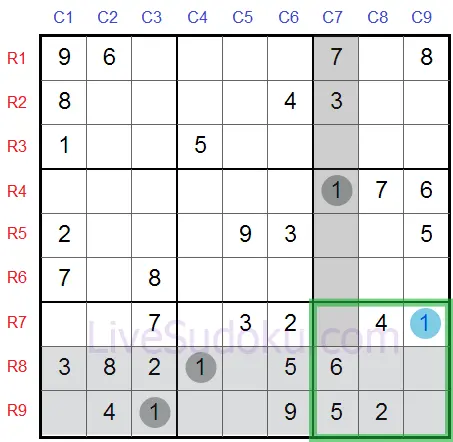
All other cells in the box are blocked. The only legal place for 1 is R7C9, so R7C9 must be 1.
Once the move is forced by the row, column, and box rules, place the digit and update the surrounding candidates.
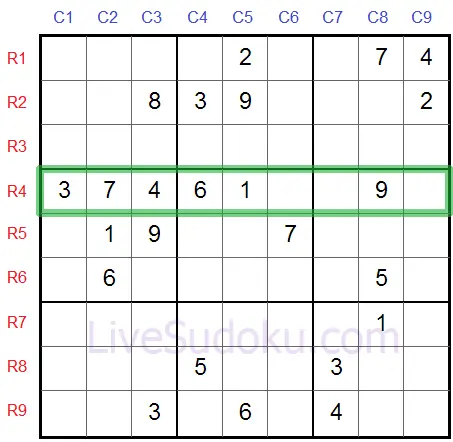
Focus on the highlighted row and test the digit 5. Do not try to solve every candidate at once.
The placed 5 at R6C8 belongs to box 6, so the empty cells in that box cannot also be 5.
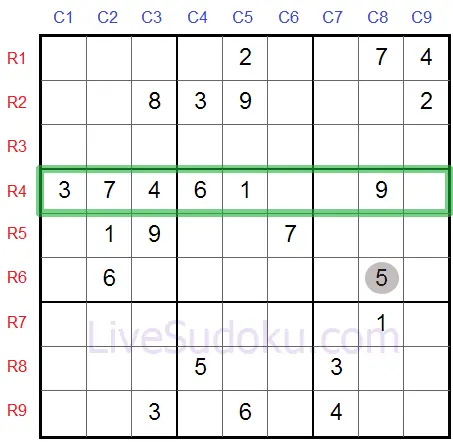
After checking the connected columns and boxes, the row has only one legal place left for 5.
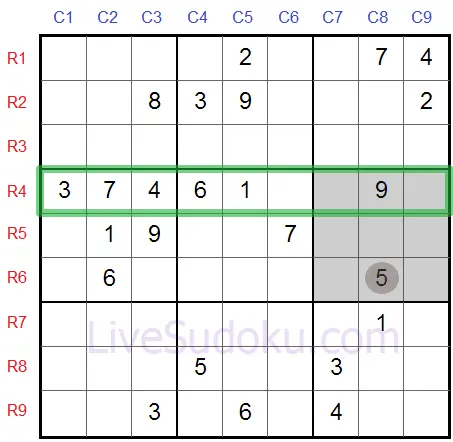
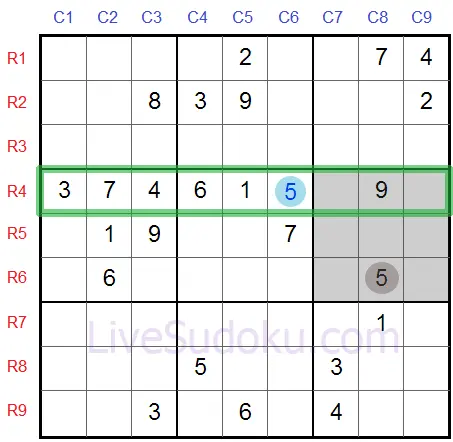
The only remaining legal cell is R4C6, so R4C6 must be 5.
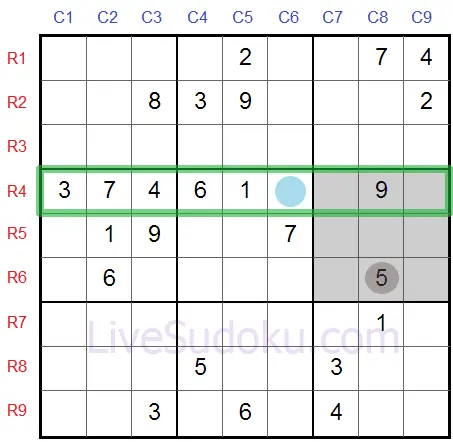
After placing 5, scan the affected row, column, and box again. One hidden single often unlocks another simple move.
Lesson complete
Nice work - you went through every step. Ready for the next lesson?
Next: Naked Singles in SudokuWhat a hidden single is
A hidden single means that a digit has only one legal cell inside a specific house: one row, one column, or one 3x3 box.
It is called hidden because the target cell may still seem to have several possible candidates. The digit is not obvious from the cell alone; it becomes obvious when you check the whole house.
Box example: finding the only place for 1
Look at the rows and columns that cross the marked box. Each placed 1 blocks the rest of its row or column from using another 1.
After those blocked cells are removed, only one cell remains available in the box. That cell must be 1.
Row example: finding the only place for 5
Hidden singles also appear in rows and columns. In this example, the question is where 5 can go in the highlighted row.
Existing 5s in nearby boxes and columns block most of the row, leaving one legal cell.
How to spot hidden singles faster
Work one digit at a time. Pick a digit that already appears several times on the grid, then check each row, column, and box for places where that digit has only one legal cell.
Hidden singles are easier to see after pencil marks are clean. If your notes are crowded or outdated, update them before looking for harder techniques.
Common mistakes
Do not call a move a hidden single just because a cell looks promising. The digit must have only one legal position in the entire row, column, or box.
Also avoid checking only one rule. A hidden single must still obey the row, column, and 3x3 box rules after it is placed.
Frequently asked questions
Why is it called a hidden single?
Because the placement is hidden inside the house: the target cell may show several candidates, and the digit only becomes obvious when you check where it can go in the whole row, column, or box.
What is the difference between a hidden single and a naked single?
A hidden single is forced by the house: the digit has only one legal cell there. A naked single is forced by the cell: only one candidate remains in it. Both are safe placements.
Do I need pencil marks to find hidden singles?
No. Hidden singles can be found by scanning one digit at a time, which is why they are usually the first technique after Full House. Pencil marks just make them easier to see in harder puzzles.
Practice next
Practice hidden singles on easy puzzles first. When you can find them reliably, move to naked singles and then pencil-mark based solving.